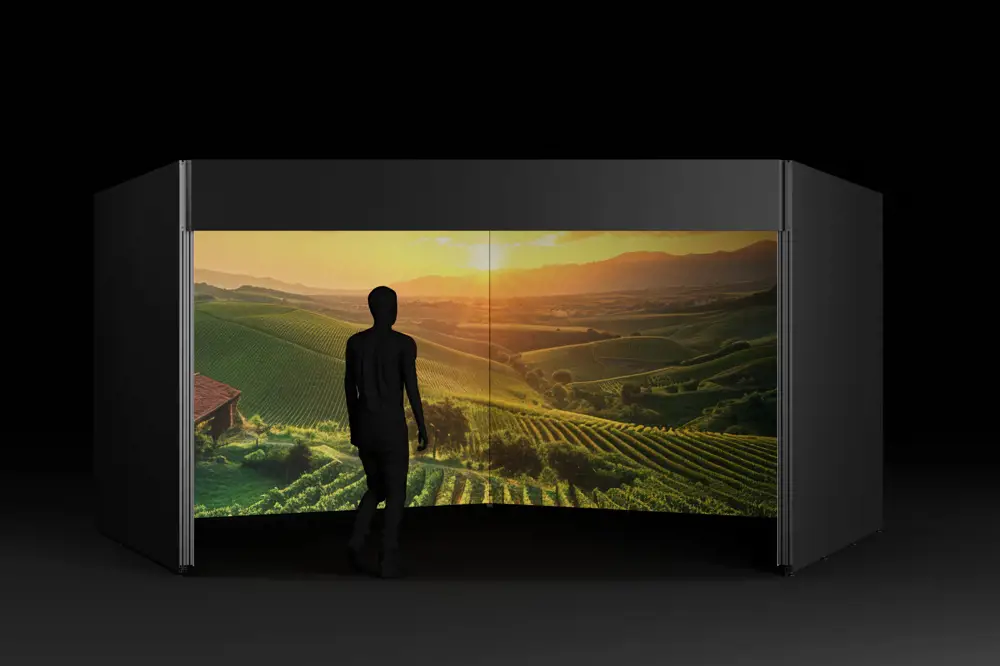
Experience learning as an engaging, multisensory journey
The Pentagonal Immersive Screen transforms education into an emotional and participatory experience.
Made of high-performance PVC fabric, it creates an immersive classroom where students and teachers can step inside the content and become active participants in the lesson.
Total Immersion
Designed for educational, museum, and training environments, this screen recreates a highly immersive and multisensory setting, stimulating focus, curiosity, and active learning.
Engaging Pentagonal Design
Its distinctive five-sided shape enhances visual depth, offering a wide projection area that can accommodate up to 5–6 people at once.
Perfect for group activities, interactive storytelling, and experiential learning paths


Why Choose an Immersive Classroom Over VR
1. Collective and Inclusive Experience
Immersive rooms allow groups of students to share the same learning experience simultaneously within a shared environment. This:
-
Encourages socialization, cooperation, and dialogue
-
Supports collaborative teaching methods (such as cooperative learning)
-
Avoids the individual isolation typical of VR headset experiences
📌 VR headsets provide an individual experience, not always easy to share within the classroom.
2. Accessibility and Immediate Usability
Immersive rooms do not require individual technological equipment:
-
No headsets to wear (which can be uncomfortable or unhygienic)
-
No issues with compatibility, dizziness, or motion sickness
-
Suitable for all ages and abilities, including students with visual, cognitive, or motor disabilities
🎯 Access is immediate — you simply enter the room and are instantly “inside” the content.
3. Real Spatial and Physical Context
The immersive room maintains the real physical space, enriching it with 360° multimedia content, projections, sound, and interactivity:
-
Students can move around, interact with peers, and observe from different perspectives
-
Lessons can be conducted in a guided way, with the teacher remaining an active part of the learning process
🚸 This is essential for school-based education, which relies on physical and pedagogical relationships.
4. Easier Logistical Management
In schools, managing 20–30 VR headsets simultaneously can be:
-
Costly (licenses, updates, maintenance)
-
Complex (batteries, hygiene, personal devices)
-
Unsuitable for long or multi-class sessions
In contrast, immersive rooms:
-
Can be used by entire classes, one after another
-
Are integrated into stable, permanent environments
5. Guided, Not Just Exploratory Learning
With immersive rooms, teachers can:
-
Guide the experience in real time
-
Interact with content alongside students
-
Integrate the experience into the curricular teaching path
In VR, on the other hand, experiences are often pre-packaged, individual, and difficult to manage in a classroom setting.