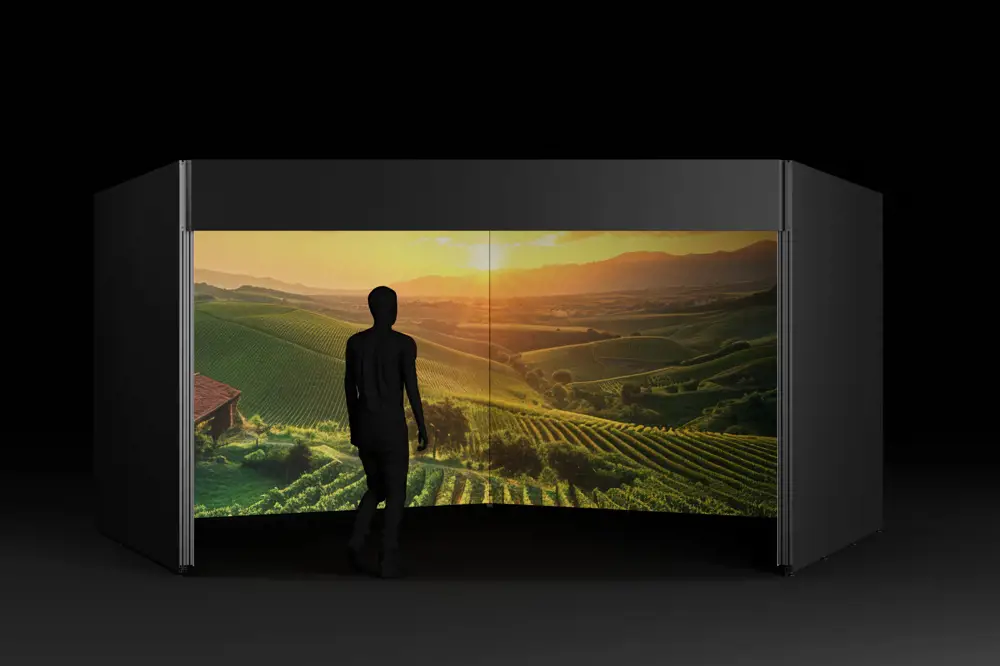
Immersive Cubic Screen 3x3x3 – Compact Structure
Designed for museum and corporate installations, the immersive cubic screen creates a highly engaging, multisensory environment. The 3x3x3-meter structure provides a well-defined, easily accessible space, designed for a fully immersive visual experience.
Total Immersion
Ideal for experiential applications, this immersive cube transforms the space into an enveloping environment, perfect for multimedia storytelling and emotional communication.
Self-Supporting Structure
Built with a stable and robust aluminum frame, the system is self-supporting and does not require any construction work (such as drywall or building permits). The PVC screens for video projection ensure excellent image quality and easy installation.
Why Invest in Immersive Learning in Schools
Immersion represents one of the most significant innovations for making education more engaging, inclusive, and effective.
In immersive environments, students don’t just study content — they live it firsthand: exploring historical, natural, or scientific settings; interacting with complex objects and concepts; and learning through experience.
This approach stimulates curiosity, enhances understanding, and strengthens memory. It is accessible to all learners — including those who struggle with traditional teaching methods — and it values different cognitive styles and forms of intelligence.
The use of immersive learning in schools also enables interdisciplinary teaching, connecting multiple subjects in a single experience, and promotes the development of digital and transversal skills. It becomes a powerful tool to guide students, prevent dropout, and offer a concrete, stimulating alternative to conventional education models.
In short, immersion is not just technology — it’s a new vision of education, centered on experience, participation, and inclusion.


Why Choose an Immersive Classroom Over VR
1. Collective and Inclusive Experience
Immersive rooms allow groups of students to share the same learning experience simultaneously within a shared environment. This:
-
Encourages socialization, cooperation, and dialogue
-
Supports collaborative teaching methods (such as cooperative learning)
-
Avoids the individual isolation typical of VR headset experiences
📌 VR headsets provide an individual experience, not always easy to share within the classroom.
2. Accessibility and Immediate Usability
Immersive rooms do not require individual technological equipment:
-
No headsets to wear (which can be uncomfortable or unhygienic)
-
No issues with compatibility, dizziness, or motion sickness
-
Suitable for all ages and abilities, including students with visual, cognitive, or motor disabilities
🎯 Access is immediate — you simply enter the room and are instantly “inside” the content.
3. Real Spatial and Physical Context
The immersive room maintains the real physical space, enriching it with 360° multimedia content, projections, sound, and interactivity:
-
Students can move around, interact with peers, and observe from different perspectives
-
Lessons can be conducted in a guided way, with the teacher remaining an active part of the learning process
🚸 This is essential for school-based education, which relies on physical and pedagogical relationships.
4. Easier Logistical Management
In schools, managing 20–30 VR headsets simultaneously can be:
-
Costly (licenses, updates, maintenance)
-
Complex (batteries, hygiene, personal devices)
-
Unsuitable for long or multi-class sessions
In contrast, immersive rooms:
-
Can be used by entire classes, one after another
-
Are integrated into stable, permanent environments
5. Guided, Not Just Exploratory Learning
With immersive rooms, teachers can:
-
Guide the experience in real time
-
Interact with content alongside students
-
Integrate the experience into the curricular teaching path
In VR, on the other hand, experiences are often pre-packaged, individual, and difficult to manage in a classroom setting.